
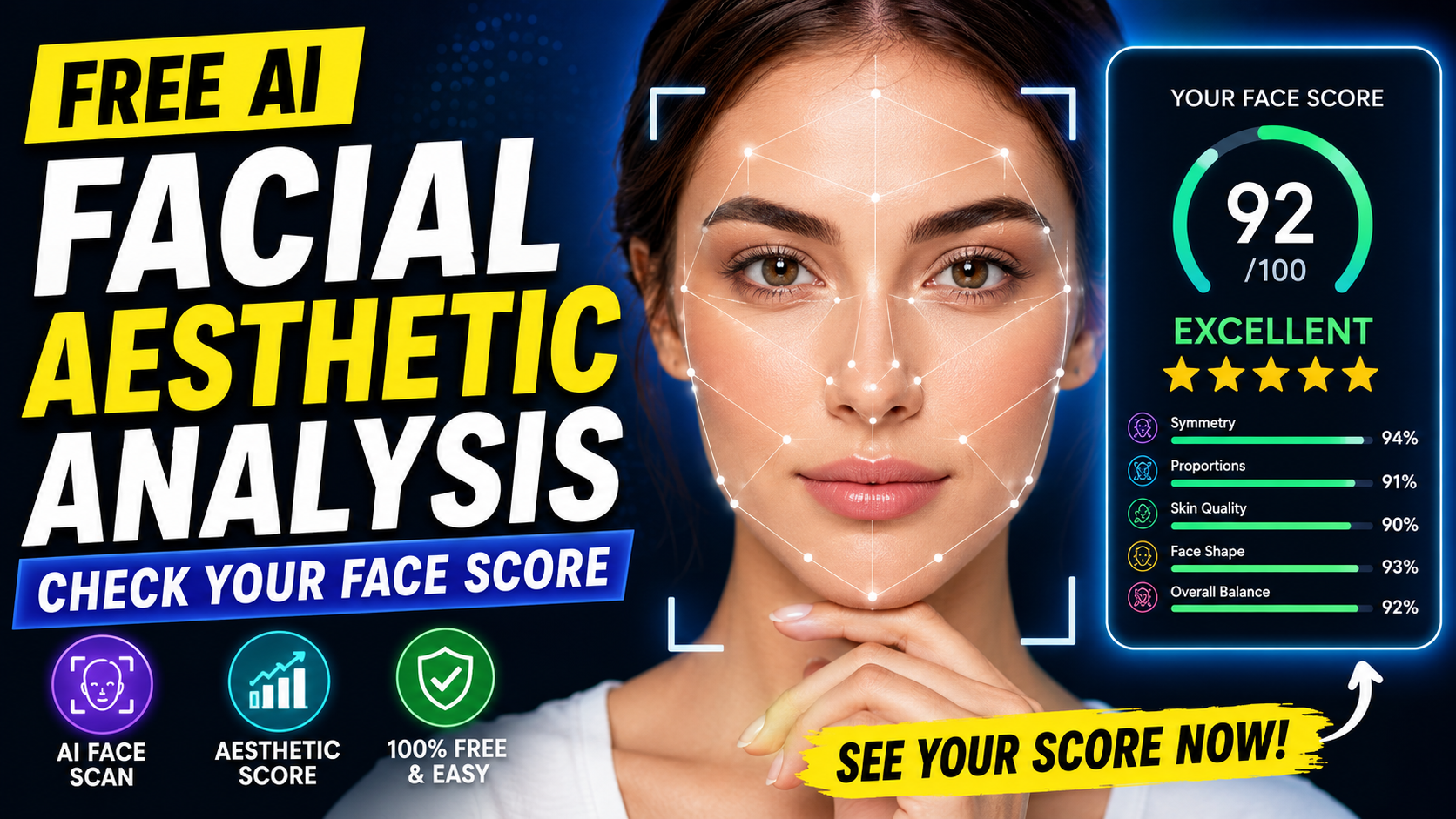
AI is transforming people’s relationship with photos, images and digital beauty tools. One of the newest trends is AI facial aesthetic analysis, which uses computer vision and artificial intelligence to analyse facial features from a photograph and generate an aesthetic or facial score. These tools are gaining popularity because they can offer an interesting way to learn about facial proportions, symmetry, balance of features, and other visual characteristics. A free AI facial aesthetic analysis tool can enable users to upload a clear photo and get an automated assessment in seconds. But be aware that an AI-generated face score is only a computer-generated estimate and not an objective measure of attractiveness, beauty or personal worth.
Thank you for reading this post, don't forget to subscribe!What Is AI Facial Aesthetic Analysis?
AI facial aesthetic analysis is a technology that employs computer vision algorithms to identify and analyse various facial areas. The AI system could recognise facial landmarks like the eyes, eyebrows, nose, lips, chin, jawline and face shape upon uploading a photo. It can then compare mathematical measurements of relationships between these points with predefined models. The end result can be displayed as a score, percentage, rating or detailed analysis depending on the tool.
The technology is generally based on facial landmark detection and machine-learning models. Some systems focus on symmetry and proportions, while others may examine factors such as face shape, feature spacing, alignment, and overall visual balance. Since different platforms use different algorithms and scoring systems, the same photograph can produce different results on different AI tools. Therefore, users should view these scores as entertainment or informational feedback rather than a universal standard.
How Does an AI Face Score Work?
The process usually begins when the user uploads a photograph. The AI analyzes the image and attempts to locate the face within the frame. Once the face is detected, the system identifies important facial landmarks. These landmarks can include the corners of the eyes, the edges of the nose, the outline of the lips, the cheek area, the jawline, and the chin.
The algorithm can then calculate relationships between these landmarks. For example, it may estimate the distance between the eyes compared with the width of the face or examine whether certain facial features appear relatively balanced. Some systems may also evaluate facial symmetry by comparing one side of the face with the other. After processing these measurements, the AI applies its scoring model and generates a result.
It is worth remembering that an AI model does not “understand” beauty in the same way humans do. Its result depends on the data, mathematical measurements, training methods, and criteria used by the particular platform.
How to Check Your Facial Aesthetic Score Using AI
Checking your face score is usually a simple process. First, choose an AI facial analysis website or application that provides an aesthetic analysis feature. If possible, select a service that clearly explains how images are processed and what happens to uploaded photographs.
Next, choose a suitable photograph. A clear, front-facing image usually works better than a photograph taken from an extreme angle. Good lighting is also important because shadows can make facial landmarks difficult for an AI system to detect. Try to use a photo in which your entire face is visible and not covered by sunglasses, masks, large hats, or other objects.
Upload the image according to the platform’s instructions and start the analysis. The AI may take a few seconds to process the photograph. When the analysis is complete, the platform may display an aesthetic score along with information about facial symmetry, proportions, face shape, or individual features.
Before uploading any personal photograph, check the website’s privacy policy. Avoid using services that request unnecessary personal information or provide unclear information about how uploaded images are stored or used.
Why Photo Quality Matters
The quality of the photograph can have a significant effect on AI facial analysis. A blurry photograph may prevent the system from accurately identifying facial landmarks. Poor lighting can also create shadows that change the apparent shape of the nose, cheeks, jaw, or other features.
For a more consistent result, use a well-lit photograph taken from approximately eye level. Keep your face relatively straight toward the camera and avoid extreme facial expressions. A neutral expression can make it easier for the software to identify facial landmarks.
Camera lenses can also influence appearance. Smartphone cameras, particularly when used very close to the face, can introduce perspective distortion. This means that a photograph may not perfectly represent how your face appears in real life. Consequently, an AI score should always be interpreted with some caution.
What Factors Can AI Analyze?
Different AI facial analysis systems use different criteria, but several common factors may be included. Facial symmetry is one of the most frequently discussed measurements. The system may compare corresponding areas on the left and right sides of the face.
Facial proportions may also be analyzed. This can involve relationships between facial width and height or the relative position of features. Some systems examine the spacing of the eyes, the position of the nose, or the proportions of the lower face.
Face shape can be another part of the analysis. An AI system may categorize a face as oval, round, square, rectangular, heart-shaped, diamond-shaped, or another category. Some tools may also provide separate observations about the jawline, cheekbones, forehead, eyes, eyebrows, nose, or lips.
However, not every platform uses the same measurements. A score from one AI system should therefore not be directly compared with a score from another system unless their methodology is known to be similar.
Understanding Your AI Face Score
An AI facial aesthetic score is typically presented as a number or percentage. For example, a platform might provide a score out of 100 and describe certain characteristics that contributed to the result. The number can be interesting to see, but it should not be interpreted as a scientific measurement of attractiveness.
A higher score does not mean that someone is objectively more attractive, and a lower score does not mean that someone is unattractive. Human perceptions of beauty are influenced by culture, personality, expression, individual preferences, fashion, and many other factors that cannot be reduced to a single numerical value.
It is better to use the analysis as an opportunity to understand how a particular AI model interprets visual proportions. If the tool identifies your face shape or provides information about facial symmetry, these observations may be more useful than focusing entirely on the final number.
Is AI Facial Aesthetic Analysis Accurate?
AI facial analysis can be technically impressive, but accuracy depends on the technology and the image being analyzed. Facial landmark detection can work very well under suitable conditions, but the interpretation of those landmarks is more subjective.
Lighting, camera angle, facial expression, hairstyle, makeup, image quality, and image resolution can all influence the result. Different algorithms may also have different definitions of an aesthetically balanced face. A model trained using one type of dataset may produce different results from another model.
For these reasons, an AI aesthetic score should be considered an estimate rather than an objective truth. Running the same photograph through multiple tools may produce different scores, which demonstrates how much the result depends on the underlying algorithm.
Is Facial Aesthetic Scoring Safe?
Before using any online facial analysis service, privacy should be one of your main considerations. A face photograph is personal information, so users should understand what happens to the image after uploading it.
Look for services that explain whether images are stored, how long they are retained, whether they are used for improving AI models, and whether they are shared with third parties. Be cautious about websites that provide little or no information about data handling.
It is also a good idea to avoid uploading photographs containing other people without their permission. If a tool allows analysis without creating an account, that may reduce the amount of personal information you need to provide, although users should still review the platform’s privacy practices.
Free AI Facial Analysis vs Paid Tools
There are both free and paid AI facial analysis services available. Free tools can be useful for casual experimentation and may provide basic information about facial proportions, symmetry, or face shape. Paid services may offer additional features such as more detailed reports, multiple analyses, or advanced image processing.
However, paying for an AI face score does not automatically make the result scientifically accurate. The most important consideration is how transparent the platform is about its methodology and limitations.
If you are simply curious about how AI interprets your facial features, a reputable free tool may be enough. There is generally no need to pay for a score simply because it promises a higher or more flattering rating.
AI Face Scores Should Not Define Beauty
One of the most important things to remember is that beauty cannot be accurately represented by a single number. Facial characteristics vary enormously between individuals, and there is no single facial structure that everyone considers attractive.
AI models are created by humans and trained using datasets. As a result, their outputs can reflect the characteristics and assumptions present in the data used to develop them. Cultural differences and individual preferences are particularly important when discussing attractiveness.
Instead of asking whether an AI score says you are attractive or unattractive, it can be more useful to think of the tool as a technology demonstration. It shows how an algorithm can identify patterns and proportions in a photograph, but it cannot capture your personality, confidence, expression, individuality, or the way other people experience your presence.
Tips for Getting a Better AI Analysis
If you want to experiment with AI facial analysis, start with a high-quality photograph. Use natural or evenly distributed lighting and keep the camera approximately at eye level. Make sure your face is clearly visible and avoid excessive filters.
Try to maintain a neutral expression if the tool recommends one. Keep your head relatively straight and avoid extreme angles. If you want to compare results, use the same photograph across different platforms rather than changing the image each time.
Most importantly, do not become overly focused on the number. Look at the explanation provided by the tool and consider which aspects of the analysis are actually useful or interesting.
Check Your AI Score
Final Thoughts
The free AI facial aesthetic analysis is an interesting example of the use of artificial intelligence and computer vision in everyday applications. Using only a photo AI is able to detect facial landmarks, estimate proportions, analyse symmetry, identify face shape and give a numerical aesthetic score.
The process can be fun and educational, but always take the results with a grain of salt. Different artificial intelligence systems can score differently due to different algorithms, datasets and definitions of facial aesthetics. Even a photograph can have an impact on the outcome, since lighting, camera angle, expression and image quality all influence how facial features look.