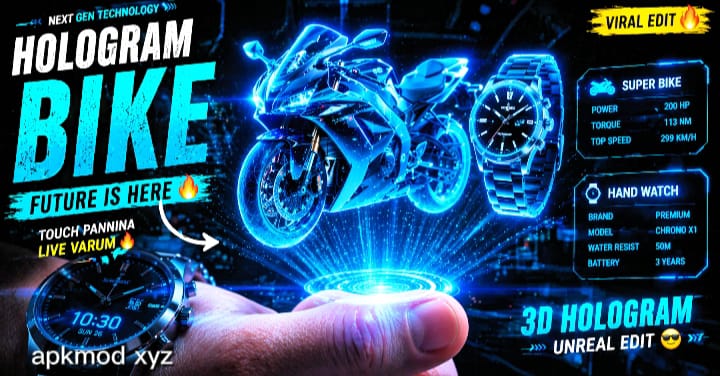
Hologram photo editing has become popular on social media in recent years. It is now one of the most viral and eye-catching trends on platforms like Instagram, TikTok, and YouTube. If you’ve seen glowing blue projections, sci-fi-style duplicates, or transparent 3D effects around a subject, you’ve experienced hologram editing in action.
Thank you for reading this post, don't forget to subscribe!What is Hologram Photo Editing?
Hologram photo editing is a digital art technique that makes a subject appear like a futuristic projection. It mimics the look of holograms seen in science fiction movies—semi-transparent, glowing, and often layered with digital effects.
These edits usually include:
- Neon glow effects (blue, purple, green)
- Transparency overlays
- Duplicate or floating body projections
- Scan lines or glitch effects
- Light particles and reflections
How to do hologram trend?
All you need to do is cut a thin clear piece of plastic, I used a strawberry container, and position it on a 45° angle in a glass container, tape it in place. Then grab your phone and search for ‘hologram animal’ videos, choose a video and place your phone screen down on the container for the magic to begin.
How to AI trend photo?
How to use an AI filter
- Open Canva. Launch Canva on the app or a web browser.
- Access the AI filter app. On the editor, click Apps on the sidebar
- Apply a free AI filter
- Polish your work
- Download or share
How to create a hologram from a picture?
Making a picture look holographic can be done by creating a DIY smartphone pyramid, using Photoshop effects, or using AI tools to create depth maps. The easiest method is constructing a plastic pyramid over a smartphone playing a video with a dark background to create a 3D Pepper’s Ghost effect.
Is there a 3D hologram?
Yes, 3D holograms exist, but they differ from the sci-fi “Star Wars” image. Modern 3D holograms are created using laser technology, specialized projectors, or spinning LEDs, producing floating, 3D images. Recent advances have even developed touchable, interactive 3D holograms that allow users to grab, rotate, and manipulate objects in midair without headsets.
How to set a hologram?
Carefully follow these steps to align and expose the hologram to the laser:
- Adjust the laser in its holder so that the beam spreads out horizontally.
- Place the object at a distance of 35 to 40 cm from the laser.
- Place a white card behind the object and adjust the laser while looking at the shadow on the card.
Prompt :
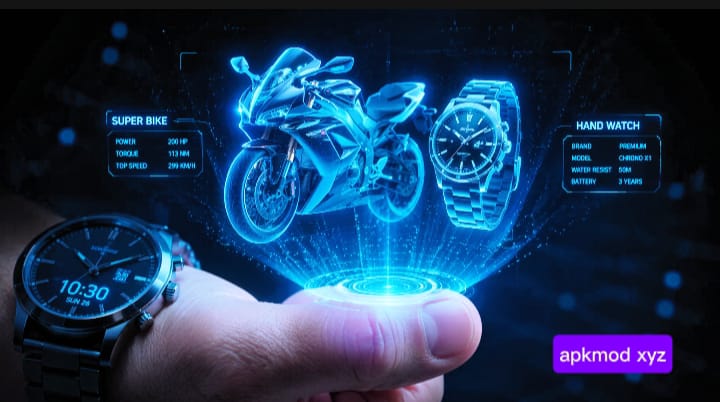
A cinematic, ultra-realistic futuristic scene featuring a sleek smartwatch on a person’s wrist in a dim, high-tech environment. The smartwatch activates and emits a vivid blue holographic interface. Concentric circular energy rings rotate smoothly around the projection, pulsing rhythmically. From the center, a detailed blue wireframe motorcycle hologram appears and begins continuous dynamic motion – rotating, tilting, and subtly shifting position in mid-air. The hologram cycles through multiple motion loops: rotating 360°, slightly expanding and contracting, and orbiting within the circular projection ring. Light particles and neon trails follow each movement, creating a layered, fluid animation.
The circular hologram interface animates repeatedly, with rings spinning at different speeds, creating a complex, synchronized motion system. The motorcycle hologram repositions and reorients multiple times, as if being previewed or scanned, maintaining smoot transitions between each movement cycle
A human finger reaches in and taps the hologram. Upon contact, the circular rings accelerate rapidly, emitting intensified light pulses. The hologram performs one final expansion cycle, then grows larger and descends toward the ground. As it touches the surface, the hologram transitions seamlessly into a solid, ultra-realistic black motorcycle. The transformation Includes high-end VFX: particle dispersion, energy waves, glowing fragments dissolving into physical materials, and realistic reflections forming across the bike’s surface. Camera movement is cinematic and fluid, with subtle zoom-ins, depth of.
What is a 4D hologram?
When these 3D visuals are also animated or updated in real time, we effectively add the fourth dimension (time) – hence “3D + Time = 4D”. This means Tekle’s holographic displays can show dynamic 3D content (e.g. moving models, simulations) rather than a static 3D image.
What is 1D, 2D, 3D, 4D, 5D?
1D–5D represents the increasing complexity of spatial and temporal dimensions, ranging from a single line to theoretical multi-dimensional spaces. 1D measures length, 2D adds width (flat surfaces), 3D adds depth (volumes), 4D adds time or a fourth dimension to 3D models, and 5D frequently represents either complex 4D spacetime models or practical, integrated data layers in BIM (cost).
Conclusion
Hologram viral photo editing is more than just a trend—it’s a powerful way to showcase creativity and stand out online. With the right tools, techniques, and a bit of practice, anyone can create stunning futuristic edits that grab attention instantly.