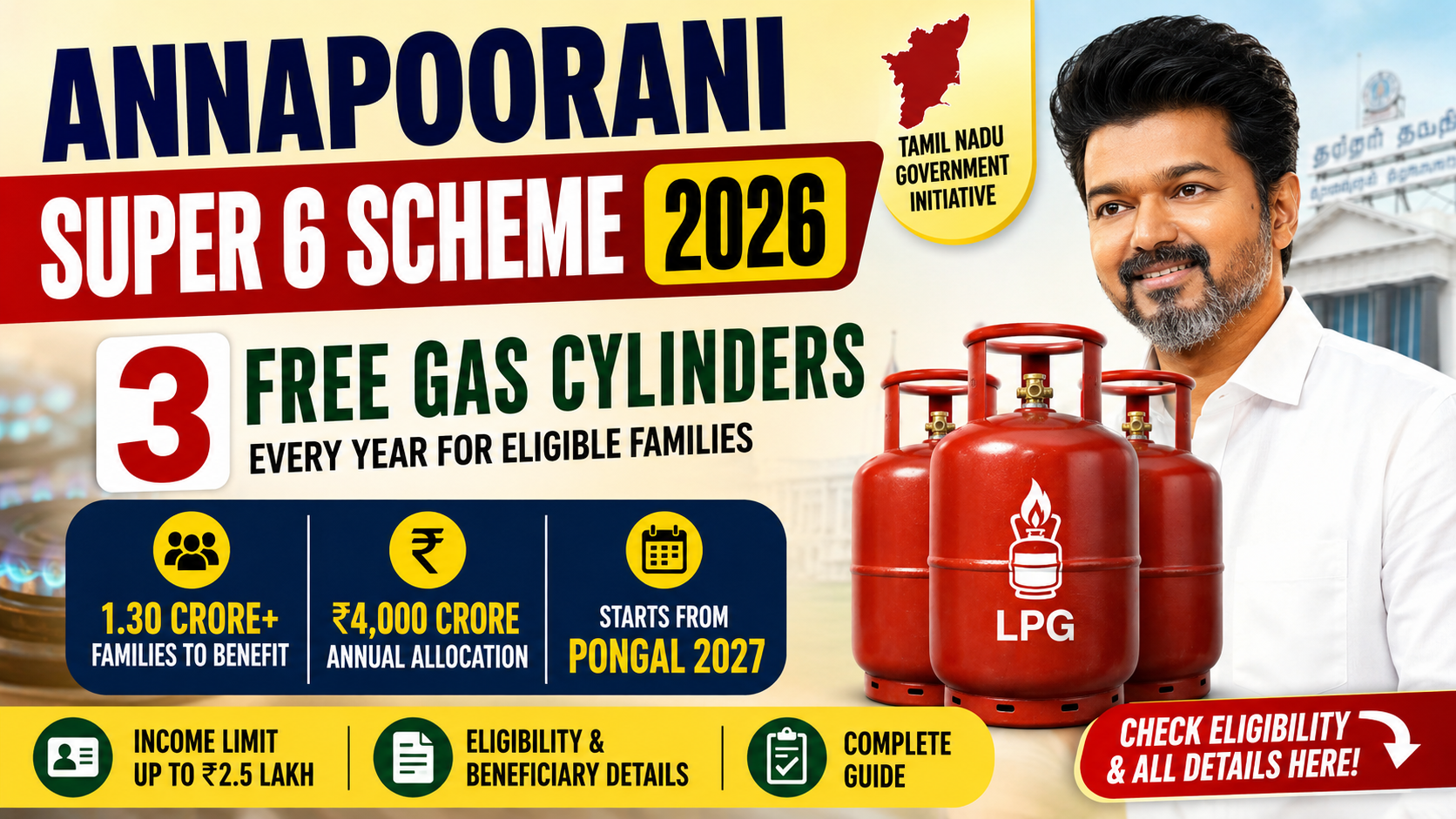
The Annapoorani Super 6 Scheme 2026 is a newly announced welfare initiative of the Tamil Nadu Government aimed at reducing the financial burden of cooking gas on eligible families. Tamil Nadu Chief Minister C. Joseph Vijay announced the scheme in the State Assembly on August 24, 2026. Under the first phase of the programme, eligible families are expected to receive the cost of three domestic LPG cylinders every year. The scheme is scheduled to come into effect around Pongal 2027 and is expected to benefit approximately 1.30 crore families across Tamil Nadu. The government has proposed an annual financial allocation of around ₹4,000 crore for the initiative.
What Is the Annapoorani Super 6 Scheme?
The Annapoorani Super 6 Scheme is designed to provide financial assistance to households that face difficulty meeting the cost of cooking gas. LPG is an essential household expense, and fluctuations in cylinder prices can have a significant effect on families with limited incomes. Through this initiative, the Tamil Nadu Government intends to reduce that burden by reimbursing the cost of three eligible domestic LPG cylinders every year.
The scheme is particularly significant because it is expected to cover a very large number of families. Government estimates reported after the announcement put the expected beneficiary count at approximately 1.30 crore families, making it one of the major welfare programmes announced by the state government. The estimated annual expenditure of about ₹4,000 crore also indicates the scale of the proposed LPG assistance.
How Many Free Gas Cylinders Will Be Provided?
Under the currently announced first phase, eligible families will receive the benefit equivalent to three domestic LPG cylinders per year. The benefit is described as reimbursement or financial assistance rather than necessarily handing over three physical cylinders free of charge at the time of booking.
Reports indicate that beneficiaries are expected to continue using the existing LPG distribution system. In other words, eligible households can book their domestic LPG cylinders through their normal distributor, while the government would provide the applicable reimbursement according to the final implementation mechanism. The exact payment procedure, timing and verification process are expected to be clarified through detailed government guidelines before implementation.
Who Can Benefit From the Scheme?
The announced scheme is aimed primarily at economically vulnerable families in Tamil Nadu. Reports indicate that households with an annual family income of up to ₹2.5 lakh are within the intended beneficiary group. The programme is also expected to cover economically disadvantaged households and other vulnerable sections.
The income limit is particularly important for families who want to determine whether they may qualify. A household should not assume eligibility solely because it holds a ration card or an LPG connection. The final government guidelines will determine how income is verified and which categories are included or excluded.
What Is the Expected Start Date?
The Tamil Nadu Government has announced that the Annapoorani Super 6 Scheme is expected to begin from Pongal 2027. This means that although the announcement was made in August 2026, beneficiaries should not expect the three-cylinder benefit to be immediately available under the new programme. Preparatory work, beneficiary identification, database verification and other administrative arrangements are expected before implementation.
Pongal is celebrated in January, so the scheme is expected to become operational around the Pongal period in 2027. The exact effective date and the rules governing cylinders booked before or after the launch date will need to be confirmed by the Tamil Nadu Government.
How Will Beneficiaries Be Identified?
The government has not yet released the complete beneficiary-selection procedure. However, reports indicate that the programme is expected to rely on existing government and LPG-related records to identify eligible households. This could make the process different from schemes that require every beneficiary to submit a completely new application.
Families should therefore ensure that their basic details are accurate in the relevant government records. Information such as the household’s ration-card details, LPG connection information, bank-account details and income-related records may become important during verification. However, the exact list of required documents should not be treated as final until the government publishes the official guidelines.
Is There an Online Application Form?
At present, a detailed official online application procedure for the Annapoorani Super 6 Scheme has not been released. There is also no confirmed dedicated registration portal or official application form that beneficiaries should use.
This is an important point because websites and social-media posts may publish links claiming to offer immediate registration. Beneficiaries should be cautious about entering Aadhaar numbers, bank details, OTPs or other personal information on unofficial websites. Until the Tamil Nadu Government announces the official application process, people should avoid paying money to agents or submitting sensitive information through unverified links.
Documents That May Be Required
The final document list has not yet been officially notified. Therefore, beneficiaries should not consider any unofficial document checklist as confirmed. Nevertheless, households may want to keep commonly used welfare-scheme documents updated and accessible.
These may include the family or ration card, Aadhaar details, LPG consumer information, bank-account details and income-related documents, depending on the final rules. The government may also use existing databases instead of requiring beneficiaries to submit every document separately.
What Is the Main Objective of the Scheme?
The primary objective of the Annapoorani Super 6 Scheme is to provide financial relief to families facing the rising cost of household cooking fuel. LPG is a recurring expense, and even a few subsidised or reimbursed cylinders each year can reduce the annual expenditure of a low-income household.
The programme also has a broader welfare objective. By helping families meet cooking-fuel expenses, the government aims to support household budgets and provide greater financial security to economically vulnerable sections. The scale of the proposed programme, covering around 1.30 crore families with an annual allocation of approximately ₹4,000 crore, demonstrates the government’s intended reach.
Three Cylinders or Six Cylinders: What Should Beneficiaries Understand?
The “Super 6” name may cause confusion because the latest announcement provides three cylinders in the first phase. Earlier campaign promises had referred to six free LPG cylinders per year, while the government announcement made in August 2026 specifies three cylinders annually under the initial phase.
Therefore, beneficiaries should currently consider three cylinders per year as the announced benefit. Claims that every Tamil Nadu family will immediately receive six free cylinders should not be treated as confirmed. Any future expansion of the benefit would need to be officially announced by the government.
Who Is Likely to Benefit the Most?
Low-income households that regularly use LPG for cooking are likely to receive substantial financial relief from the programme. Families with annual income within the announced ₹2.5 lakh threshold may be among the principal beneficiaries. Economically disadvantaged families and other vulnerable groups are also part of the intended coverage.
For a household that purchases several LPG cylinders during a year, reimbursement of three cylinders could represent meaningful savings. The actual monetary benefit, however, will depend on the cylinder price and the final reimbursement rules announced by the government.
Important Points Before Applying
Beneficiaries should remember that the scheme has been announced but its complete implementation framework is still developing. The expected launch is Pongal 2027, and detailed information regarding registration, documents, beneficiary verification and payment procedures is yet to be formally published.
People should also distinguish between an official scheme announcement and unofficial websites claiming to accept applications. Do not pay registration fees for a government welfare scheme unless an official notification clearly states that a fee is applicable. Similarly, do not share OTPs, banking passwords, ATM PINs or other confidential information with individuals claiming to process the benefit.
Frequently Asked Questions
What is the Annapoorani Super 6 Scheme 2026? The Annapoorani Super 6 Scheme is a Tamil Nadu Government welfare initiative intended to reduce the LPG expense of eligible families by reimbursing the cost of three domestic LPG cylinders per year in its first phase.
How many LPG cylinders will be provided? The currently announced benefit is three LPG cylinders per year for eligible families. The earlier six-cylinder promise should not be confused with the currently announced first-phase benefit.
What is the income limit? Reports on the announcement state that families with annual income of up to ₹2.5 lakh are intended to be covered. Final eligibility and verification rules are subject to the government’s detailed notification.
When will the scheme start? The scheme is expected to begin from Pongal 2027.
How many families are expected to benefit? The government estimates that approximately 1.30 crore families could benefit from the programme.
Is the online application open now? A detailed official registration process has not yet been released. Beneficiaries should wait for the government to announce the official application and verification procedure.
Apply Link
Conclusion
The Annapoorani Super 6 Scheme 2026 is an important new LPG assistance initiative announced by the Tamil Nadu Government. Under its currently announced first phase, eligible families are expected to receive reimbursement for three domestic LPG cylinders every year, with the programme expected to begin around Pongal 2027. Families with annual income up to ₹2.5 lakh are among the intended beneficiaries, and the scheme is expected to cover around 1.30 crore households with an annual allocation of approximately ₹4,000 crore.