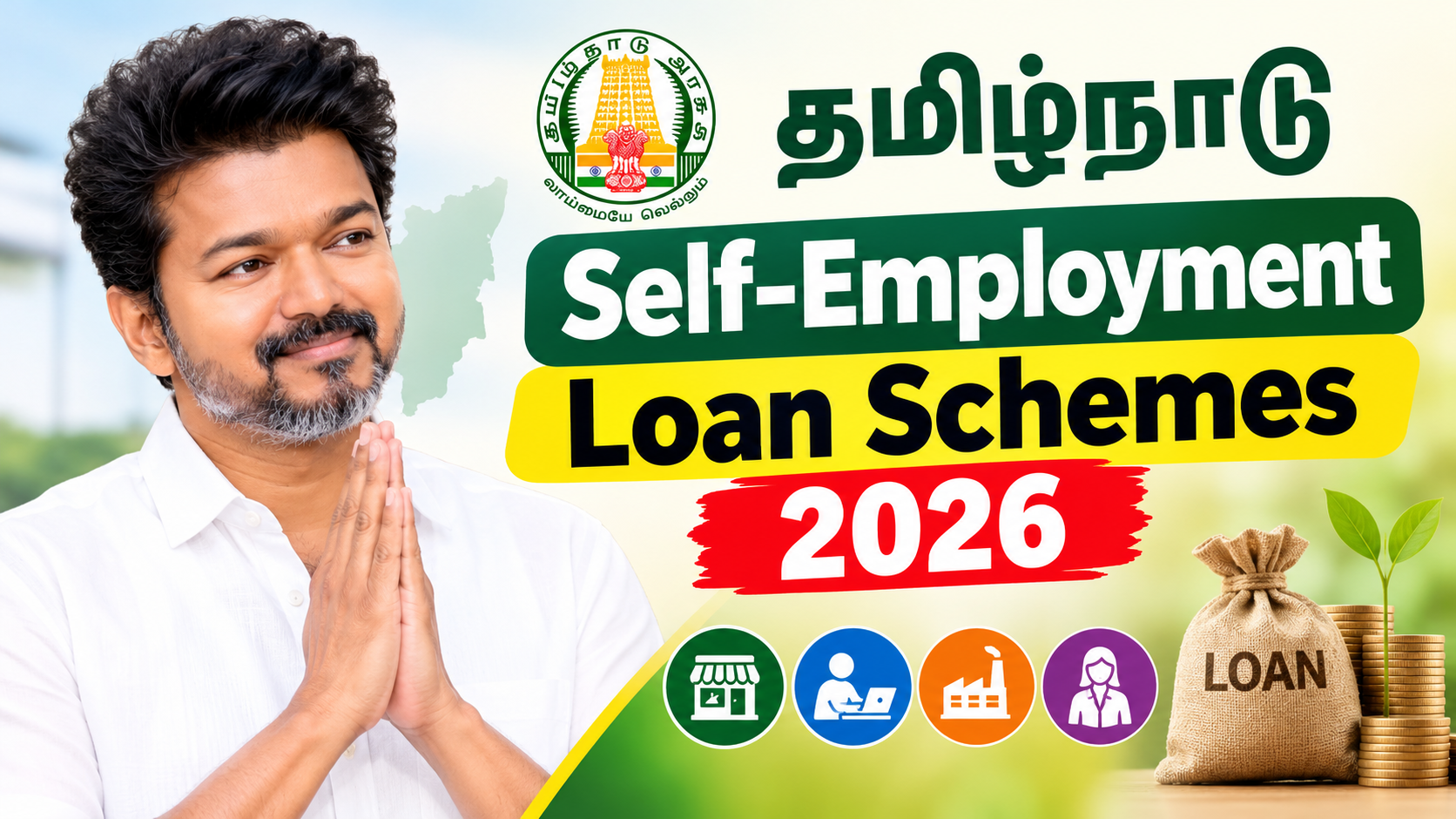
Tamil Nadu Self-Employment Loan Schemes 2026 can help eligible people explore financial assistance for starting a small business, purchasing equipment, expanding an existing enterprise, or developing an independent source of income. Self-employment creates opportunities for unemployed youth, women, small entrepreneurs, artisans, and people living in rural and urban areas. The Tamil Nadu Government and various government-supported financial institutions offer different loan and subsidy programmes for eligible applicants. These schemes have different eligibility requirements, loan limits, interest rates, and application procedures.
Thank you for reading this post, don't forget to subscribe!What Are Tamil Nadu Self-Employment Loan Schemes?
Self-employment loan schemes provide financial support to eligible individuals who want to start or expand income-generating activities. Depending on the scheme, applicants may receive a business loan, a government subsidy, interest assistance, or a combination of financial benefits. These programmes can support businesses such as tailoring shops, grocery stores, beauty parlours, mobile repair centres, food businesses, transport services, agricultural activities, and small manufacturing units. However, loan approval is not automatic.
1. TAHDCO Self-Employment Schemes
The Tamil Nadu Adi Dravidar Housing and Development Corporation (TAHDCO) implements economic development programmes for eligible Scheduled Caste and Scheduled Tribe beneficiaries. Certain programmes support first-generation entrepreneurs who want to establish their own businesses.
For example, the Vettri Thozhil Munai vor Thittam, also known as the Vettri Thozhil Munai vor scheme, is listed by the Kallakurichi district administration with eligibility conditions for SC/ST applicants aged 18 to 55 and an annual family income limit of ₹3 lakh. The published scheme details mention a capital subsidy of 35% of the project cost or ₹3.5 lakh, whichever is lower, along with a 6% interest subsidy. Applicants must verify the current rules and availability with TAHDCO before applying.
Official information: https://kallakurichi.nic.in/tahdco/
2. TABCEDCO Individual Loan Scheme
The Tamil Nadu Backward Classes Economic Development Corporation (TABCEDCO) provides financial assistance to eligible people belonging to Backward Classes (BC), Most Backward Classes (MBC), and Denotified Communities (DNC). Its Individual Loan Scheme supports eligible applicants who wish to establish viable businesses or income-generating activities.
The official TABCEDCO website lists a maximum loan amount of ₹25 lakh under the Individual Loan Scheme, with interest rates and repayment periods varying according to the loan amount and applicable terms. The published eligibility criteria include an age range of 18 to 60 years and an annual family income limit of ₹5 lakh. Other conditions also apply, including restrictions on multiple loans within a family. Applicants should check the current scheme guidelines rather than assuming that every applicant can receive the maximum amount.
Official website: https://tabcedco.tn.gov.in/
3. Prime Minister’s Employment Generation Programme (PMEGP)
The Prime Minister’s Employment Generation Programme is a central government scheme implemented through designated agencies to encourage new micro-enterprises in the non-farm sector. Eligible entrepreneurs can apply for bank-linked project finance with a margin-money subsidy under the programme’s applicable rules.
PMEGP may be suitable for people planning to establish small manufacturing or service businesses. Applicants must satisfy the programme’s eligibility conditions, and the project must fall within the permitted categories. The amount of assistance depends on factors such as the project cost, applicant category, location, and scheme guidelines. The applicant must contribute the required share, and the lending bank assesses the proposal before deciding whether to approve the loan.
Applicants should use the official portal to review the current guidelines, application procedure, and required documents.
Official website: https://www.pmegp.msme.gov.in/
4. Self-Employment Assistance for Persons with Disabilities
Eligible persons with disabilities can explore self-employment assistance through the Tamil Nadu Commissionerate for the Welfare of Differently Abled. The department lists schemes supporting small enterprises and self-employment ventures, subject to the relevant eligibility conditions.
For example, the published information for micro-enterprises and bunk stalls describes a subsidy of up to ₹25,000 or one-third of the sanctioned loan amount, whichever is lower. The department also lists assistance connected with PMEGP for eligible beneficiaries. Applicants should contact the District Differently Abled Welfare Officer to confirm which schemes are currently available, the documents required, and the process for obtaining assistance.
Official website: https://www.scd.tn.gov.in/self_emp_sub_schemes.php
5. Businesses That May Qualify for Financial Assistance
Depending on the selected scheme, eligible business proposals may include tailoring and garment production, grocery and provision stores, food preparation and catering, beauty salons, photocopy and printing centres, mobile phone repair shops, small manufacturing units, handicrafts, dairy farming, poultry, and transport services. A business idea should address a genuine local demand and demonstrate how it can generate sufficient income to cover operating expenses and loan repayments.
Before applying, prepare a simple business plan that describes the products or services, expected customers, setup expenses, equipment requirements, estimated monthly revenue, and ongoing costs. Obtain quotations for machinery or equipment where required. A clear and realistic plan can help the department or lending institution assess the viability of the proposed enterprise.
Eligibility Criteria for Self-Employment Loans
Eligibility differs from one scheme to another. Common requirements may include Tamil Nadu residence, meeting the prescribed age limit, belonging to an eligible community or beneficiary category where applicable, satisfying family income limits, and proposing a permitted business activity. Some schemes support new entrepreneurs, while others may permit business expansion under specific conditions.
Documents Required for Application
Applicants should prepare the documents requested under their selected scheme. Commonly required documents may include:
- Aadhaar card or another accepted identity document.
- Address proof or nativity certificate.
- Community certificate, where applicable.
- Income certificate, where required.
- Family card or ration card, where required.
- Passport-size photographs.
- Bank account details and applicable bank documents.
- Educational or skill certificates, if required.
- Business project report and equipment quotations.
- Disability certificate, where applicable.
- Driving licence or other business-specific permits, where required.
The final document list depends on the scheme and the implementing department. Check the official application instructions before submitting originals or copies.
How to Apply for Tamil Nadu Self-Employment Loan Schemes 2026
First, identify a suitable scheme based on your business plan, eligibility, income category, and community requirements. Second, visit the relevant official website or contact the district-level office responsible for that scheme. Third, read the eligibility rules, subsidy conditions, repayment terms, and application instructions carefully.
Next, collect the necessary certificates and prepare a business project report. Complete the online application if the scheme provides an online facility, or obtain the application form from the authorised office if offline applications are accepted. Upload or submit the requested documents and save the acknowledgement or application reference number. If a special loan camp is announced in your district, contact the organising department to confirm the date, venue, eligibility, and whether applications can be submitted at the camp.
Benefits of Self-Employment Loan Schemes
These schemes can help eligible applicants reduce the financial barriers involved in starting a business. Depending on the programme, assistance may include access to institutional credit, capital subsidies, interest subsidies, or support for purchasing equipment. A successful business can generate regular income, create employment opportunities, improve family finances, and serve local customers. However, applicants should compare interest rates, repayment schedules, their own contribution, and all applicable conditions before accepting a loan.
Important Tips Before Applying
Choose a business that matches your experience, skills, and local market demand. Borrow only the amount required for a realistic business plan. Read the loan agreement carefully and understand the repayment schedule, interest rate, security requirements, and consequences of missed payments. Confirm that the scheme is active for the current application period and that the information you are using comes from an official government or authorised financial institution website.
Conclusion
Tamil Nadu Self-Employment Loan Schemes 2026 may provide valuable opportunities for eligible entrepreneurs who want to establish or expand a business. Programmes offered through TAHDCO, TABCEDCO, PMEGP, and the Welfare of Differently Abled Department serve different categories of applicants and have different eligibility rules. The best approach is to identify the appropriate scheme, prepare a practical business plan, collect the required documents, and apply through the authorised channel.