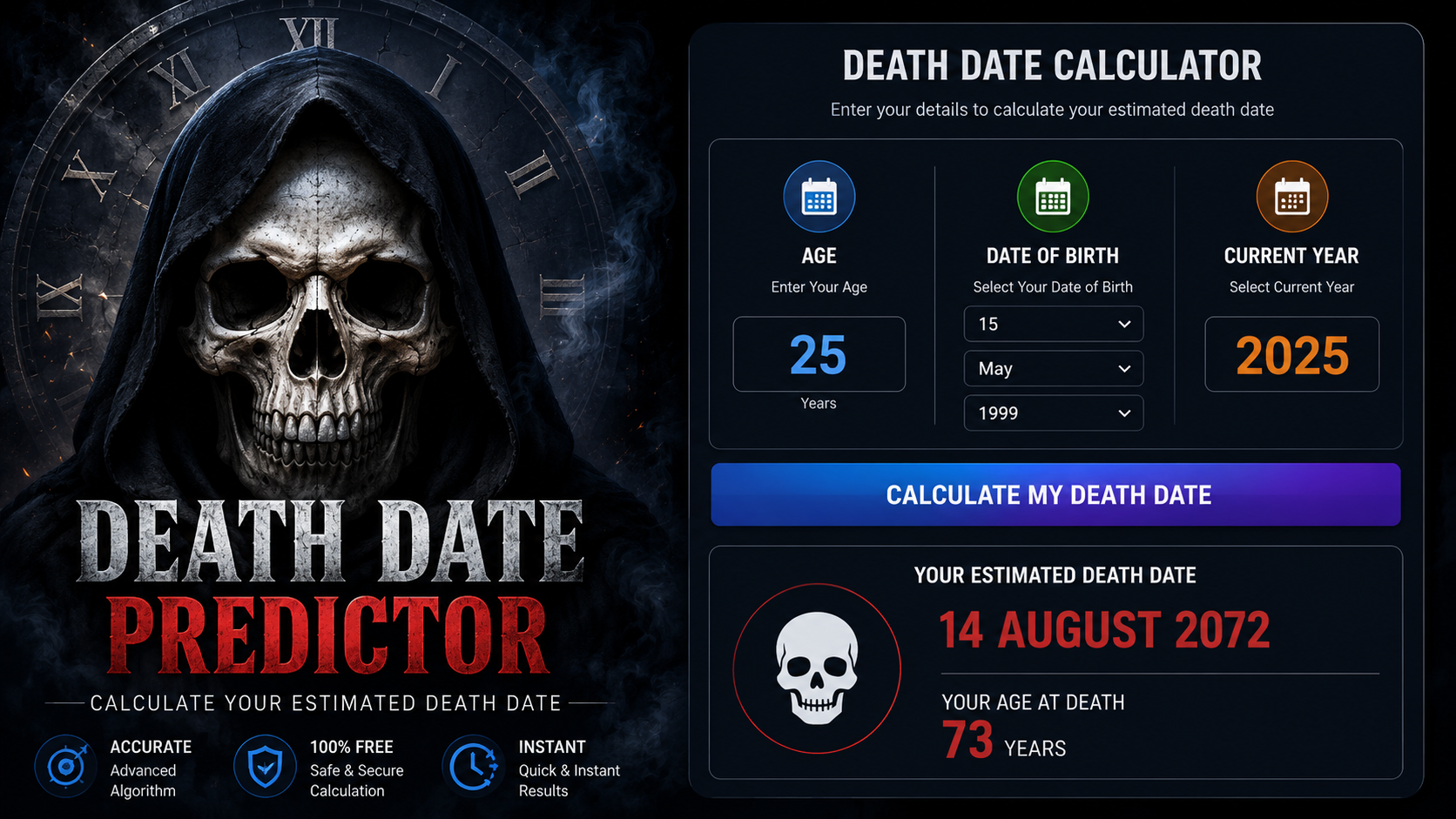
Death Date Predictor – Free Online Death Clock Calculator provides fun, and offers an estimate of your life expectancy using general lifestyle data and statistics. A lot of people get curious about how long they may live and this sort of calculator offers a fascinating estimate based on their age, gender, height, weight, smoking history, exercise program, and general health. These calculators are a great way to play but should not be used as a reliable indicator of future performance. There is no website, AI or calculator that will ever be able to tell you exactly when anyone dies.
Thank you for reading this post, don't forget to subscribe!What Is a Death Clock Calculator?
A Death Clock Calculator is an online tool that estimates a person’s expected lifespan using life expectancy statistics and health-related information. Instead of making a real prediction, it compares your details with average data collected from population studies.
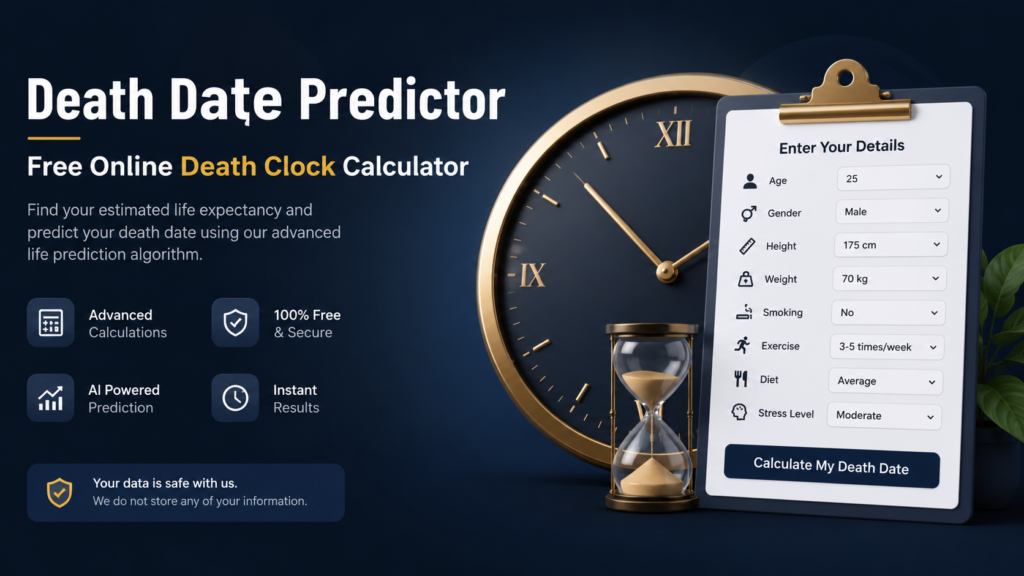
Most calculators ask for basic information, including:
- Current age
- Gender
- Height and weight
- Smoking habits
- Alcohol consumption
- Exercise routine
- Diet
- Stress level
- Country or region
Based on these details, the calculator estimates your remaining years and may display an approximate future date as part of the experience.
How Does the Death Date Predictor Work?
A Death Date Predictor works by combining your personal information with average life expectancy statistics. Advanced calculators may also use artificial intelligence to analyze lifestyle choices and compare them with health research.
The calculation generally follows these steps:
- Collects your personal information.
- Evaluates lifestyle habits.
- Compares your data with life expectancy averages.
- Calculates an estimated lifespan.
- Displays an estimated death date and remaining years.
Remember, this process is based on probability rather than certainty.
Information Required for the Calculator
Most free online death clock calculators require only a few basic details to generate an estimate.
These commonly include your age, biological sex, height, weight, body mass index (BMI), smoking status, alcohol use, physical activity level, diet quality, sleep habits, and stress level. Some calculators may also ask about existing medical conditions or family history to improve the estimate.
Providing more accurate information usually results in a more realistic life expectancy estimate, but it still remains only an approximation.
Is the Death Clock Accurate?
The simple answer is no. There is no day and no year that can be exactly determined for the death of a person by the help of a calculator.
There are many factors which contribute to life expectancy such as genetics, accidents, medical advances, environment and random events in life. These variables can’t be completely calculated using a web-based calculator.
The results are informative, entertainment and should not be considered as a fact medical information.
Factors That Influence Life Expectancy
Many factors can affect how long someone lives. A Death Clock Calculator usually considers only a small portion of these.
Some of the biggest influences include healthy eating, regular exercise, quality sleep, avoiding smoking, limiting alcohol consumption, managing stress, maintaining a healthy weight, receiving regular medical checkups, and having access to quality healthcare.
Positive lifestyle changes often improve overall health and may increase life expectancy over time.
Benefits of Using a Death Clock Calculator
Although it cannot predict the future, a Death Clock Calculator offers several interesting benefits.
It encourages people to think about their health and lifestyle. Seeing an estimated lifespan may motivate users to quit smoking, exercise more, eat healthier foods, reduce stress, and schedule regular health checkups.
Many users also enjoy comparing results after making lifestyle improvements to see how healthier habits can influence estimated life expectancy.
Who Can Use This Tool?
A free online Death Date Predictor can be used by almost anyone who wants to explore life expectancy statistics.
Students, fitness enthusiasts, healthcare bloggers, researchers, and curious internet users often enjoy testing these calculators. Since they require only basic information, they are simple and easy to use on desktop computers, tablets, and smartphones.
The tool is designed for educational and entertainment purposes rather than medical diagnosis.
Tips for Living a Longer Life
Instead of worrying about an estimated death date, it is much more helpful to focus on healthy daily habits.
Exercise regularly for at least 30 minutes most days of the week. Eat plenty of fruits, vegetables, whole grains, and lean proteins. Drink enough water throughout the day. Avoid smoking and limit alcohol intake. Sleep seven to nine hours each night. Manage stress through meditation, hobbies, or spending time with family and friends. Visit your doctor regularly for preventive health screenings.
These habits contribute far more to long-term health than any online calculator.
Why People Search for Death Clock Calculators
Death Clock Calculators have become popular because people naturally wonder about their future. Social media trends, AI-powered tools, and curiosity often encourage users to try these calculators.
Many users share their estimated results with friends simply for fun. Others use the experience as motivation to improve their lifestyle after seeing how healthier habits could increase estimated life expectancy.
The growing popularity of AI has also made these tools more engaging and interactive.
Important Disclaimer
It is important to understand that a Death Date Predictor cannot predict the future. The estimated date shown by the calculator is generated using statistical averages and should never be interpreted as a real forecast.
If you have concerns about your health or life expectancy, consult a qualified healthcare professional rather than relying on an online calculator.
Death Clock Calculator
Conclusion
Death Date Predictor – Free Online Death Clock Calculator is interesting as far as life expectancy is concerned with lifestyle and statistical data. The results are fun and stimulating to read, but not to be interpreted as predictions of fact. The future is unpredictable and no technology will be able to say exactly when anyone is going to die.